Showing posts with label Break barrel. Show all posts

Friday, 28 April 2017

.177 BSA Cadet, A Review and Other Bits and Bobs


For an old air rifle that i always thought a bit of a smallish youth rifle, i was pleasently surprised to find it both considerably larger and heftier when i first laid my hands on one. 

109 cm from tip too tail

The very first thing i did though was to put her over the chronoghraph to get 4.56 ft/lbs with JSB Exacts, she was old, complete and in fairly good nick and i reckoned things could only improve from here on in.

This has the look of a sporting rifle in the 50's

 BSA was responsible for the production of over 50% of all British small arms produced during WWII, so roll on 1945 and they decide to go back to an increase in thier Air rifle production and the introduction of thier new Cadet air rifle. Capable of putting out 8 ft/lb and advertised as being able to take rabbits out to 50 yards this rifle was popular amongst young adults and adults alike, trade description was not an issue in those days. Maybe if you could throw the thing 50 yards you could possibly concuss a rabbit, with a full wooden stock and heavily engineered steel construction the rifle had some interesting early BSA design features and had to be one of the prettier looking break barrel air rifles for it's time.

The prefix of CC tells me the rifle is made in the later half of the 1950's

The Cadet has a leather piston seal which in this case needed no oil to improve velocity, from what i remember from the chrony test there was no more the 25 FPS spread with any of the pellets i tested. From what i could see through the cocking slot both spring and piston appeared to be lightly lubricated, or at least it wasn't all dry and dusty. 

The Cadet has a one peice trigger and sear that hooks on to a central piston rod in the piston, how much of the sear that holds the piston rod can be adjusted by a screw in the slope at the rear of the action.

Without dimantling the rifle i had to looke at the plans on Chambers web site too find out this adjusted sear engagement.

 The stock is a one piece beechwood affair with a very long cocking slot, because it has a single piece cocking rod that is, like the rest of the rifle, very well made and solid.

Considering the length of the cocking slot, there was no movement in the stock, not one bit, non at all, zero, zilch.


The stock fits well to the action and is fixed with two screws at a 60 degree angle at the front of the action,

Screws made the old fashioned way, roled on the thighs of dusky Brummies.

and like the later Airsporter and Mercury the rear is a bolt that runs through the pistol grip and screws into the rear section of the action. 

The reat bolt. Like it say's on the tin, bolts the rear on.

The Cadet has some weight to it for its size as i said before and although it is pretty old there is no movement between the forks, or anywhere at all come to think of it, from wear over the years.


I have no idea if a pin or a bolt holds the forks around the breech, it's still a solid fit though.

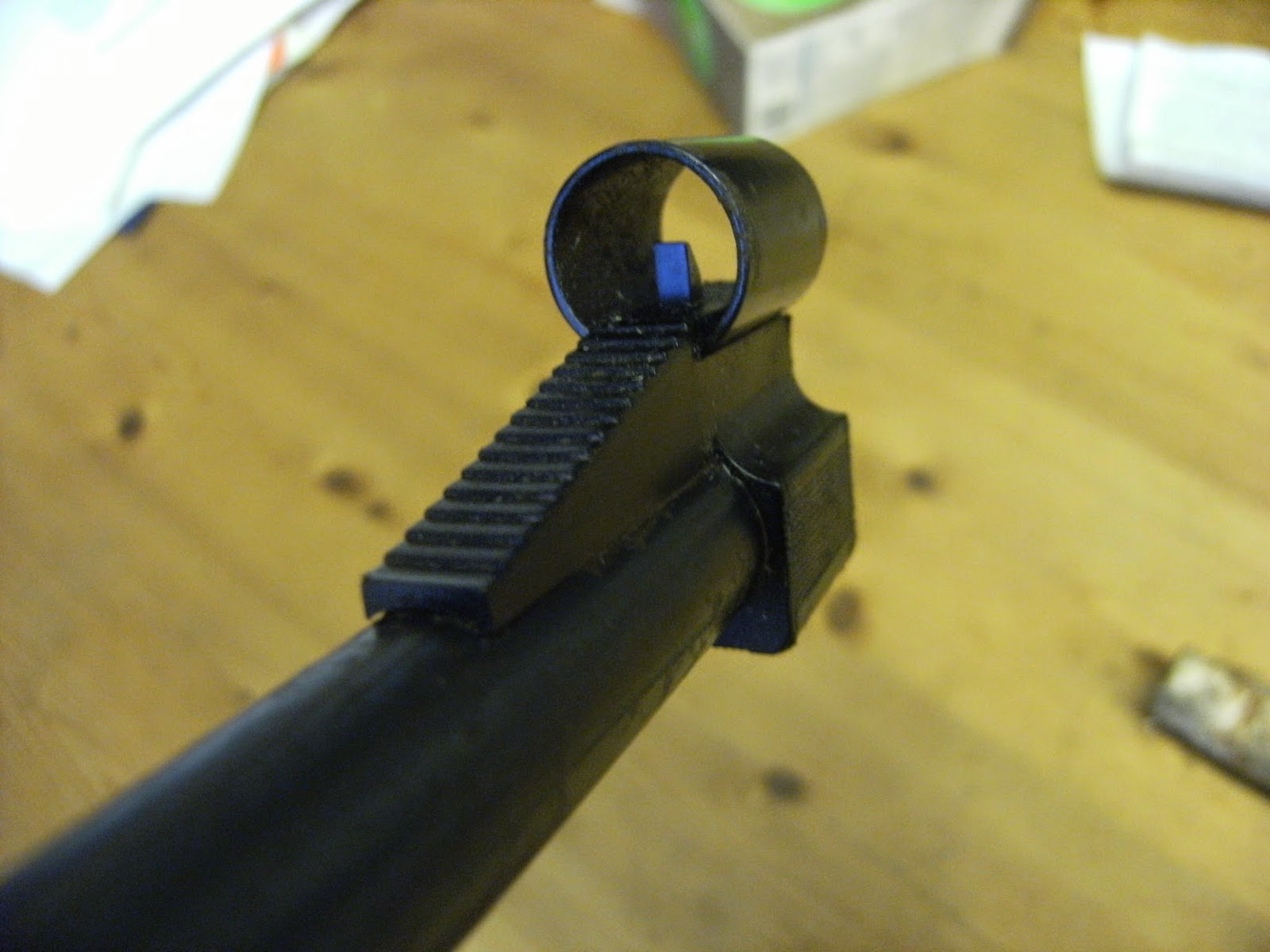
There are only open sights on this rifle and has no scope rail, because scopes just weren't commonly used in the 50's. The front sight is a bead on top of a concave ramp that sits in a dovetail on the tip of the barrel, left to right adjustment could be achieved by tapping the sight along the dovetail.

The front sight had already been adjusted and was fine, notice it hangs over too the right.


From this angle the dove tail is more noticable.

The rear sights that sit on top of the breech block are real old school and tend to be found on most early 1900's air rifles, they adjust up and down only by spinning a firm horizontal thumb wheel. This allows a plate with a V notch on top to move vertically in its frame, score marks on the side of the frame and plate help keep track of adjustments


These sights were perfectly fine in the 50's and still perform well today.

The trigger and guard are very slim but also pretty solid due to the fine quality of the metal used to build it. The trigger appears to have a light too mediun release and along with the angle of the pistol grip and the low combe on the buttstock, found it very comfortable too shoot with satisfying results.

The trigger guard design is a tried and tested BSA design and can be found on later Meteors

Low recoil, trigger release, weight, and pretty nifty old school sights all added up to some good off hand accuracy. 7 out of 9 Geco wadcutters made one impressive one cm ragged hole and JSB Exacts appeared to spred vertically, however they were the only two pellets i tried at the time.

I reckon Superdomes would do well in this air rifle, should get some really.

When all is said and done, the BSA Cadet is an awesome back yard plinker that reeks of nostalgia from a time we can only imagine and most likely never happened.

This rifle came to me in good condition internally and out, and as a plinker did not need any attention apart from a little oil and wire wool for the matal work. It's fun and definately gets a thumbs up.

All the best,

Wing Commander Sir Nigel Tetlington-Smythe 

Wednesday, 28 January 2015

ASI Sniper Vs The SMK 15, A Comparison Test.


Comparing two cheap youth air rifles made 30 years apart.

The ASI Sniper is a youth air rifle also known as the Gamo Expo. It was popular during the late 70's and early 80's. This model is .177 which was capable of reaching power levels of around 9.5 ft/lb; mine is currently happily reaching 6 ft/lb since I dropped some oil down the transfer port to put a bit of life into the leather piston seal.

ASI Sniper, i really like the feel and looks of this rifle.


Just shy of 6 ft/lb.

The SMK 15 is aimed at the same age group and with a bit of tweaking could reach 9 ft/lb, though at the moment is fine knocking out .177 pellets at around 6 ft/lb. 

More like 5 ft/lb but does do 6 ft/lb with Hobby's.

Like ASI, SMK is an import company which buys up air rifles from different parts of the world, re-brands them in their company name and sells them on at a cheap rate compared to rifles with a well recognised brand name. They have been doing this from the late 80's onwards and are still doing it today.

SMK 15, quirky little thing that it is.

ASI took Gamo and El Gamo rifles and sold them on cheaper than their competitors, and SMK took cheap massed produced Chinese air rifles and sold them on at, in some cases, a considerably cheaper price. Recently, SMK have been given the import rights for air rifles from big names like Diana, Remington and Gunpower, to name but a few. But my favourite at the moment are Swiss Arms and Cybergun which make the .177 BB replica pistols, though if truth be told they're actually made by KWC and re-branded. Since then, Gamo have grown larger and now own BSA, and have an extensive range of air rifles and pistols on offer.

So there you have it, two similar imported air rifles made three decades apart. I plan to do a comparison test between them to see which one out performs the other, if indeed one does out perform the other. Two air rifles imported by British companies who buy cheap air rifles and put them on the British market cheaper than other brands - one is Chinese, one is Spanish.

 
Chinese made especially for SMK.


Gamo mark and country of origin. Rick Lamphere of Rick's Shop blog told me this was also sold as the Daisy 120 in the USA.


The open sights on both are pretty solid with no slackness to them and almost identical in looks; front square post with a hood, and rear square notched sights, click adjustable for windage and elevation.

Rear sights for the ASI Sniper.


Rear sights for the SMK15, both mostly plastic but pretty solid all the same.

Both are break barrels and their power plants produce roughly the same power. Cocking effort for both feel the same, though the SMK spring is stiffer and slammy on firing and the Sniper is softer with more pre-load. The trigger on the Sniper feels noticeably lighter than the one on the SMK, but neither are what you would call light triggers by a long shot.

The ASI Sniper trigger has adjustment for sear contact, but a long pull.


The SMK 15 rigger has a long pull and a stiffer break.

Both rifles are pretty much the same in size, looks and weight, and most importantly both rifles are in a .177 flavour which, with all factors combined, make them perfect for this comparison test.

Two rifles ready for testing, (and the SIG Sauer X Five pistol for a bit of fun after the test)

For this test, all shots were taken while sitting, with the air rifle supported in front of the trigger guard at their points of balance. The pistol grip was held as lightly as possible and the butt plate gently rested in my shoulder, giving both rifles chance to recoil freely and (hopefully) in the same way for each shot. Both rifles were tested with the same four types of pellets at 12 yards, once with open sights and once with a 4 x 32 scope with five shots per group to give a general idea of performance and accuracy.

So from 12 yards I sat down and shot at a paper target with the ASI Sniper, with just the open sights as I had forgotten to bring the allen key to take the SMK 4x32 scope off the SMK 15. Using RWS Superdomes, AA Diabolo's, Geco Wadcutters and H&N FTT's, I shot groups of five. The trigger was heavy and this was the first time I had really fired this rifle, but despite that it was very comfortable to shoot.
   
Not a brilliant set of groups for the Sniper but they will tighten up with practice, besides i'm short and long sighted so open sights are a bit of a chore. Also it was 12 yards not 10 like it says on the target paper

Then, using the same pellets in the SMK 15 with the 4x32 scope, I shot five of each at 12 yards. I had to remember to take the safety off and the trigger was a tad stiffer, with the rifle being a lot harsher to shoot. Even with the scope, the groups were larger than the ASI with open sights. I would say the fact that the ASI was well run in helped out here, and again it was the second time I had ever shot the SMK.

The SMK with a 4x32 sights was no better than the Sniper without, but Superdomes and H&N's seem the way to go if i'm going to try and improve on this.


Days later when the weather had settled down again, I swapped the scope over to the ASI and took both rifles out again. I had ran out of Superdomes but I did have a new tin of JBS Exacts to try instead. I gave the SMK 15 a go with open sights first, but the spread was that bad that I gave up and didn't even bother recording the results.


After three days of howling winds we're back out with the scope swapped over to the Sniper and a brand new tin of JBS Exacts.

   
However, when it came to the ASI Sniper with the 4x32 scope, the results were a lot better - remember this was only the second time I had fired this rifle. The Diabolo's and Exacts gave amazing groups considering, but it didn't seem to like the H&N's. The Geco's were not too bad and they are pretty cheap pellet, so a decent Wadcutter could give results as good as the Diabolo's and the Exacts.

The line of shots at the top left are sighting in shots, but on the whole i'm pretty chuffed with these results and with the JBS Exacts as well.

So there you go, two cheap air rifles from decades apart and it looks like the Spanish Gamo won hands down. With a little fettling the ASI could have the power brought up, the trigger made lighter, and still be a smooth shooting accurate air rifle. The same could be done for the SMK 15 as well, but to me it sounds a bit like polishing a dog turd, afterall you can only do so much with cheap air rifles.

TTFN

Best wishes, Wing Commander Sir Nigel Tetlington-Smythe


PS. Please don't think that I am of the opinion that all Chinese air rifles are crap. Some are pretty good. You just get what you pay for really, and with a bit of time and effort working on them some people have achieved amazing results.

Sunday, 25 January 2015

The High Power ASI Sniper Micro Accuracy (Gamo Expo)


This was generally how rusty all the exposed metal work on the rifle was when I first picked it up.
 
My shed was getting full of junk that I keep picking up on the off chance that i'll find a use for it; I do that a lot and have found some good stuff, though lately I have managed to cut down. However I decided to take a car load of junk down to the recycling centre. I decided to ask if they ever have any air rifles or air pistols that they keep hold of to sell. They said they do sometimes and went off to have a look for me ... what they came back with was a break barrel that had rusted shut, they said I could have it for £5.

Rusty old air rifle out of a bin.

It was a .177 ASI Sniper micro accuracy, a Spanish air rifle made by El Gamo or Gamo, called the Expo. They were fairly popular in the late 70's and early 80's as they were even cheaper than a BSA Meteor or even a Relum.

Slap on a sticker and it becomes an ASI

The stamp on the breech lets you know what model Gamo it is.

It's a small to medium rifle that in it's day would do around 8-9.5 ft/lb in .177 or upto 10.5 ft/lb in .22 on a good day with the wind behind it.

Three drops of oil and dieseling gives an extra 3 ft/lb.

Not a light trigger but apparently surprisingly accurate, and for an air rifle from the 70's/80's looks pretty cool in sort of semi-tactical way. 

Spacious trigger guard.

A molded plastic trigger guard, square muzzle break with metal hood and hooked butt pad give it this look. 

The muzzle break protects the crown of the barrel.


Hard plastic butt pad that's a tad too small for the stock.

There was even a version that had a repeating mechanism that stored pellets in a tube, as did others of their models, and they were responsible for the iconic ASI Paratrooper around this time as well which was even more tactical looking. 

Rear sights worked just fine even when rusty.

Anyway, the point is that I snapped it up as at that price it was worth it for the full set of open sights alone, besides, it just needed spraying in 3in 1 oil and it would be cocking again.

One of the rustier parts.

The stock is in pretty good condition and is made from beech I presume, with an orange looking varnish and no interesting grain at all. 

Quite a plain finish on the stock.

The plastic butt pad is too small for the stock with the stock end overhanging top and bottom; if the the stock was re treated and the wood taken down it would look a lot better. 

There is a plastic end cap on the compression tube that sits at an angle, it looks like it comes off a BSA Meteor and with some wood removed from the stock would sit straight. 

With a shallow recess cut into the stock the Meteor end cap will sit straight.

The fore stock stops well short of the forks and barrel and slope back at an angle, very much like the stock off the later Relum break barrels; like them it has a slightly raised comb with cheek piece on the left, typical of air rifle stocks of the 70's and 80's (well the cheaper ones anyway).

With a bit of a clean, the stock came up surprisingly nice!

The plastic shaped trigger guard, plastic end cap, and plastic muzzle break with hood are really the only things that give it it's own identity over other air rifles of the era. 

Barrel looking tidier and a good square front sight post,

Of course, metal hoods that usually fall off and get lost eventually tend to date the rifle, and of course no tru-glo sights. 

to match the square notch on the rear sight

Hold it against an SMK 15 and it actually looks quite modern, but ill fitting parts do let it down a bit.

Rub wire wool with oil into the rust.


See the scum it lifts while not touching the enameling or bluing.


Leaving it a different looking air rifle all together.

After an hour with wire wool and some oil, nearly all the rust was removed, leaving behind 95% enamel and some patches where the rust had removed it, mainly at the front of the compression chamber and along the barrel.


Pitting left on the more rustier patches of the enamel.

Spraying some oil around the forks soon got the barrel to move, and moving the barrel back and forth for a while had it cocking and moving freely in no time. The rear trigger guard screw connects it to a lug at the rear of the compression tube and the two screws in the fore stock go in at a slight angle.

The larger bolt at the rear of the plastic trigger guard screws into the lug on the compression tube.

Underneath there's no rust at all but one of the fore stock screws is stripped at the end. Without the stock on, the damaged screw does bite and hold, so I swapped them around and they both held with the stock on, though I will most likely drill one of the stock holes a couple of mm deeper and that should solve the problem saving me having to replace the damaged screw which will definitely need to be done if I fit a new main spring.


Hole for fore stock bolt on the under side will need drilling 3 mm deeper.


The outside of the barrel is mildly marked with rust but looks nice and straight though possibly leaning slightly to the left; anyway, with extra rubbing with wire wool and oil it looks pretty nice. 

Barrel and plastic muzzle break comes up clean and shiny.

An interesting thing about the barrel is that it is a rifled .177 barrel liner made of what looks like stainless steel with an outer casing to bring it up to 15 mm; I believe this is not an uncommon practice with Gamo even today as it a system they use on many of their air rifle barrels. Anyway it's nice and shiny and needs only a brief clean, lets see just how that effects the accuracy stakes.

What looks like a stainless steel rifled barrel liner.


This rifling is very clean.

 When the stock was off I could see that the main spring appeared slightly lubricated and was not dried up. The articulated cocking linkage slides over a metal stud inside of the stock.

Metal ball to hold articulated linkage in place.

It cocked fairly smoothly with enough pressure to show the main spring still had some life in it still. In fact, it was knocking out Superdome's at around 5 ft/lb.

Just under 5 ft/lb straight off.

with a few drops of oil on the leather piston seal this should go up a little, in theory. 

About 6 ft/lb with oil settled into leather piston..

A new main spring and rubber O ring breech seal should also improve things some more, but the main spring is the same that fits Relums and Meteors and I have a few of those so it's just a matter of using the best one for now. I don't want to put too stiff a spring in as it will make the trigger quite stiff and it's just fine at the moment, it feels a little gritty but a clean and lube should improve that.

Simple trigger and sear with adjustment for sear contact.

For a cheap old air rifle it's a bit of a tidy find and nothing appears to be missing from when it was new, it scrubs up nicely and shoots fairly smoothly considering it's age. As it is, it will make a lovely little plinker or youth rifle, but with a fair bit of tinkering it could become a nice light short range hunting rifle dispatching rodents with some quality hollow points. 

Looking better after a clean.

This is one of those air rifles that people want nowadays because it reminds them of one they had as a kid back in the days when no one gave a second glance at a couple of young lads off down the fields with a couple of air rifles. One of my mates had one of these and one had a Paratrooper, whereas I had an old Webley Hawk if memory serves me well. Anyway, that's it for now.

TTFN

Best wishes, Wing Commander Sir Nigel Tetlington-Smythe